Alkonost
noun
1. Russian folklore
The Alkonost is a legendary woman-headed bird in Slavic folklore. Alkonost is more likely an individual character, as was noted in some legends about this bird
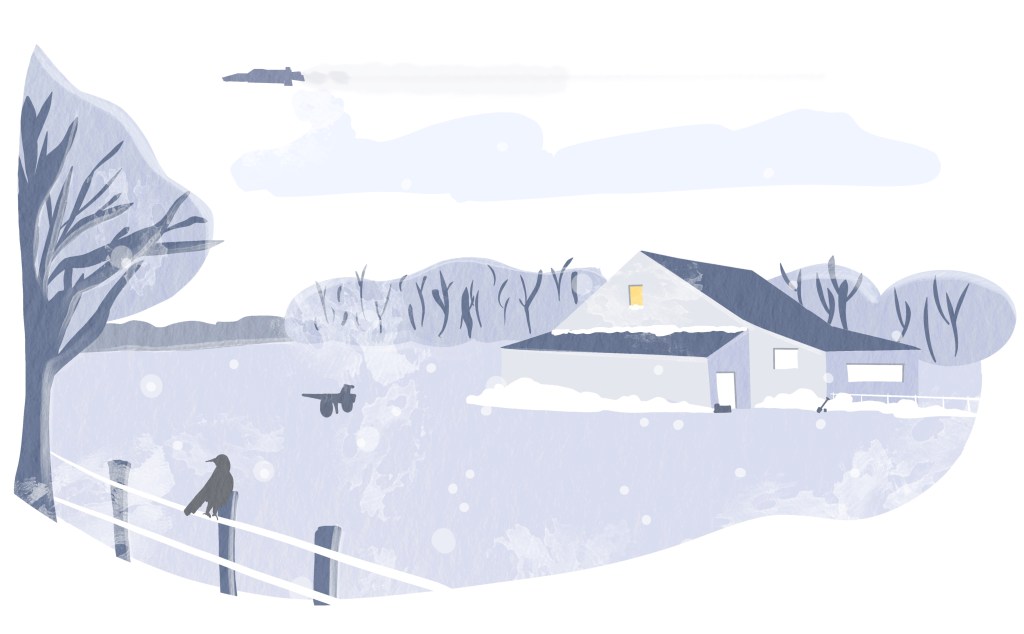
They came at night, rattling up the drive in a Lada Legionnaire that’d seen better days. Three men. Two rifles and a shotgun, shouldered and shivering in winter coats, asking after her father.
‘He died,’ she told them from behind the barrel of her own .762. ‘Last year,’ she replied when they didn’t, ‘during the thaw.’
The man closest, greying and strip-thin, stepped back off the door, out of the spilling light, ‘our condolences,’ he sighed.
‘Ok,’ she said, steady.
Earlier in the day, she’d stepped into her father’s old boots and walked his steps around the lonely patch of winter he’d come to tame. She’d walked down the long track to the road, clearing snow, then walked the boundary fence she’d been fixing the week before last. Passed the old shed, where the wood was melting away from frost and icy wind, and checked the locks – still firm.
She’d checked the old house and collapsed pre-fabs at the southern limit for old sheets or things she could salvage for the new barn. Empty handed, she’d checked the new barn too, and the couple of old Kalmyk cows she’d managed to save. Mucked out, water replaced, and more spule logs added to the burner, she’d shut the doors tight against the chill, worried their water trough would freeze overnight, worried she might always smell like shit and smoke and slushy damp.
By midday, the light was already starting to fail. Her breath caught in the rising wind, foggy phews that fought, went ragged, and drifted off to join the thickening clouds. She walked up the cleared drive to the new dacha where her father had lived, scuffing through new snow that’d already frozen on the dirty days-old stuff to set herself back to the task of packing up.
She’d started in his bedroom, a small room at the back of the house with a view to the southern fence, and out to the taiga beyond. She folded old shirts, surrounded by a thick perimeter of drawers and wardrobes where he’d stashed his life. She worked standing at the end of his bed to catch the last warmth from his little fireplace, where the white wintery light was best.
She matched suits with carriers she’d had drone-delivered from Lomonosov, their stale, dusty smell mixing with the fading coals and his aftershave’s sandalwood.
She brushed down his old uniform and picked lint off his long sleeves and epaulettes. She shined the pips and buttons and hung it on the back of his door near his still-polished, pristine shoes, and while she worked, she hummed. An old song of his that he’d hummed always, for her, probably without realising, long and slow, high. She remembered him in his own way, quietly noisy, the way he’d whistle if it went quiet for a little too long.
In a drawer, she’d taken out scarves, a watchbox with no watch inside, cufflinks, a gold ring scuffed and brassy. She found an old set of keys in a ball of socks, thick rectangular things on a battered carabiner. They knocked together, heavy as she bounced them in her palm, reminding her of a spring day years before.
Growing up, she knew her father dreamed she’d join the Air Force.
She’d played with Sputniks and Vostoks and cosmonaut dolls. For school, she’d dressed as Sofia Morozov, ‘the FTL heroine who’d made her people dream of space again,’ he’d said. He’d bought her the stiff woolly uniform from a shop of Savitskaya Square somewhere in the shadowy ulitsas outside the Krepost.
On her sixteenth birthday, they looked at photos together in the morning, drinking creamy raf. At lunchtime, warm and bright, they packed into his old Lada Pioneer and drove, leaving Lomonosov and the sprawling company suburbs and landing fields, windows down, coats off, with the smell of pine and spule drifting in off the winding lanes.
They left the lowlands behind, made it up through the pass where the land flattened out to forests and fields and powerlines. He hummed, of course, tapping out the rhythm on the steering wheel, while she chattered on, pointing out birds and pastures of Kalmyks.
He pulled the Lada off at a checkpoint. Marshals in politsiya uniforms approached the car, and smiled when they saw her father. ‘Afternoon, Major,’ they’d said, and waved them through.
They pulled up to a hangar on a bare strip of carbocrete set back from a long, faded runway. He’d opened her door and helped her out, while she’d asked questions. He’d just smiled, said ‘Come on, help me with the door.’ Together, they dragged the hangar doors open, cold metal grinding unstuck and screaming on its runners.
It was gloomy inside and while her eyes had adjusted, her father had walked to the middle of the space and pulled an old mottled canvas off a lumpy boulder. He dragged it away, clapped the dust off his hands with pounding echoes.
Between them, she saw for the first time the Gamayun he’d kept. A black and squat shuttle, with hard-angled edges and stubby wings over the two main atmo-engines.
He took her hand and walked her round it, pointing out where he’d removed missile racks and hollowed out the gun ports for extra manoeuvrability. He traced the welds with her hands, beamed as he scrubbed the clean edges with his sausagey fingers. He made her repeat the motions, showed her the repainted NO STEP signs and where he’d fitted the new Sochistellar sensor bulbs he’d found in a surplus store outside Tryptiev. He showed her the canopy and its three-pane, quartz and silica-glass viewers.
At the end of their circle, looking at it head on, he took her hands in his. ‘This bird will take you anywhere you want to go. Anywhere on Dyshka, even, where human feet have never touched our pristine snows, or up to the glaciers of the north, or the sunken islands round the equator. She can take you to Pavlov’s Star,’ he said, out past the solar limit, and if you see a star there you like Sirina, she’ll take you there too.’
‘She?’ it didn’t look like a she, she thought.
‘Oh yes,’ he’d said, ‘all great ships are women, and all great women fly ships.’
Looking at him, feeling his hands hold hers, she believed him. That she’d join the Air Force too.
She led the men into the boxy living room he’d kept. Found them glasses from a box in the kitchen, and the last of a bottle of ararat. Nothing special.
When she returned, they’d switched the holovision to C-NAI, the rolling 22-hour a day system news.
She handed them a glass and poured each a nip of the brandy. They shifted in their puffy coats, still warming.
‘Thank you, Sirina,’ the grey strip of a man said, settling on the couch.
‘Of course,’ she said, and took her own place on the rug, close to the fire.
He took a sip, sighed. ‘I am Grigori,’ he said.
‘The trade secretary,’ she said.
‘Yes.’
The holovision coverage moved onto air strikes in Tereshkova raion.
‘I see,’ she said, ‘and you?’ She asked the others.
‘This is Lev, my driver,’ Grigori said about the blond man nodding off in her father’s armchair, ‘and Pavel,’ who perched on the sofa arm, closest to the door.
‘And what does Pavel do?’ She asked.
‘Security,’ Pavel said. His eyes drifted from the HV to meet hers. A little smile, maybe tired, maybe mean, played on his lips. He was tall with mousey hair. There was dark stubble starting on his cheeks and chin and throat.
‘Yes,’ Grigori said.
She looked back at Grigori. His eyes were pits, bruise dark and drooping.
‘Pavel makes sure I don’t get into too much trouble.’
A log popped as it caught.
‘Welcome.’ She raised her glass. They followed suit.
‘Your father,’ Grigori said.
She smiled politely and drank.
Pavel, watching her, finished his glass. ‘Now we’re all introduced,’ he said.
‘We are,’ Grigori said. ‘You know, Sirina, we’ve met before. Yes,’ he said when she didn’t reply, ‘before your father retired. Oh. You can’t have been more than eight or nine.’ His smile surprised her.
‘I don’t remember,’ she said, and ‘I’m sorry,’ because she was.
‘You played with the model shuttles from my desk… Well,’ he let it drift.
‘It was a long time ago,’ Pavel offered.
Kozyol, she thought, asshole.
‘I visited the Krepost a lot when I was young,’ she said instead.
‘Yes. Yes of course,’ Grigori said. He looked back at the coverage on the HV. The anchor bantered with her co-host, segued into the next story on the weather. She was expecting a storm, soon, maybe a day away, 2 at most.
The lounge was warm from the fire and the extra bodies, and the HV anchors chattered. Grigori finished his glass. Lev snored.
‘We should go,’ he announced, coat scuffing as he made to stand.
‘No,’ Pavel said, ‘the storm.’
‘It could last for days, Pavel—’
‘Worst case scenario,’ Sirina said
Pavel shrugged, ‘look at Lev,’ who was snoozing now.
‘We couldn’t possibly!’
‘No,’ Sirina said, ‘he’s right.’
‘It could last days,’ Grigori said.
‘And you’d be safer here,’ Pavel said.
‘He’s right.’
Grigori turned from Pavel, to her, to the HV. He seemed to shrink a little.
‘We’ll sleep here,’ he motioned to the couches.
‘Ok,’ she said.
‘Pavel, you’ll stay up?’ He waved his arm at the HV as he sank back to the couch.
‘Yes.’
‘Ok,’ Grigori said.
‘Ok.’ Sirina finished. She stood, legs aching, back warm from the fire. She fetched them blankets and a couple of extra cushions she found in a cupboard.
Coming back, she noticed they’d stood a couple of their guns up in the coat stand, lined up their boots by the door. There were little gluts of mud ground into the old fading carpet.
‘Here.’ She set the things down on the sofa beside Grigori. Lev was still asleep, boots dripping.
‘Thank you.’ Grigori replied. Now coatless, he started to settle.
She left.
‘Goodnight,’ Pavel said. He cleaned his rifle.
Upstairs, she locked herself in her father’s only guestroom. She shared the bed with her rifle. Put her rings and her fathers keys on the bedside table.
She listened as the house settled around her, the little creaks it made and the way the pipes clicked in the walls. The embers cracked as they died in her little fire. Through the floor, she heard the humming coverage from the news they’d left on quiet in the lounge.
She tugged wool-rough bedding closer and, for a while, dreamed of her bunk in Iriyev.
Footsteps scuffed the stairs and woke her. The floorboards creaked as someone passed her door. Went into the bathroom.
Her breath caught. Adrenaline buzzed in her arms, legs, fingers. She tensed, coiled.
The toilet flushed. Taps turned, water shhing as it hit the cracked sink.
The bathroom door knocked as it opened.
Footsteps again. Closer, louder. The landing creaked with whoever was passing. Going past her door. Stopped. Two feet, shadows from the landing light.
She listened, hard. Shifted, careful, trying to hear. Her chest thumped. She tried to move the rifle, quiet.
The shadow feet moved,
The staircase creaked with footsteps heading downstairs.
She woke to hushing voices, speaking fast and serious. She dressed and laced her boots.
Grigori, Pavel and Lev were gathered around the HV, she couldn’t make it out. Sometime in the night, they’d let the fire burn down. It was cold. She should relight it, she thought, before they started to see their breath.
‘What is it?’ She said to their backs.
‘Oh Sirina,’ Grigori said, shuffling to make space for her.
‘That,’ Pavel said, pointing at the screen, ‘is the worst case scenario.’
Night, Lomonosov, the capital, aflame. Shaky footage of aerofighters flashed through red-flare and fiery clouds, dropping concussive shells into streets clogged with crashed autocabs and burned out shop fronts. Explosions thundered and flashed with shrapnel and debris. People screamed in the battered streets, climbing over rubble and out of broken buildings, trying to find refuge, desperate and nearly-naked in the cold. That’s how they’d die, she knew, blackened by hypothermia, coughing up frozen lungs.
‘We’re bringing you these pictures live from Lomonosov this morning,’ the anchor, female – probably Marta Ivanova – told them off screen in a somehow, practised professional tone. ‘This is a breaking story and reports are still coming in, but what’s apparent at this stage is there’s been attacks across the capital this morning. Early reports indicate these started just after 3am—’
‘Der’mo,’ Sirina said, shit, her heart was pounding in her chest. She tasted bile. How many of her friends, her colleagues, were already dead?
The picture changed. Ash and snow swirled against columns of black, greasy smoke, snapping flames climbing. Iriyev port, in the Tryptiev raion. A runway littered with aerofighters, commercial shuttles, smashed and blazing. There was rubble where hangers and the administrative buildings used to be.
‘They hit Iriyev,’ Lev said.
‘The air force,’ Pavel agreed.
‘I told them,’ Grigori said, so sad ‘I told them this would happen.’ Sirina, in spite of herself, surrounded by these strangers, took his hand.
‘We’re now getting reports,’ Marta continued off-screen, leaving all the pixel space possible for them to watch the horror unfold in HD, ‘that armed figures stormed the Krepost around the same time. Armed police have met resistance—’
‘And been caught completely off guard,’ Marta’s co-anchor, Arseny Popov, chipped in.
‘Yes,’ Grigori said.
They watched images of black, armour-clad politsiya balance guns on the opened doors of their cars. Sirens lit the night and the dim gates of the Commissariats government complex. There was more fire, and more snow.
‘At this stage, we don’t know the status of the government,’ Marta was saying off-screen. ‘It appears the situation on the ground is complex, and events are moving quickly—’
Sirina topped up their brandy. They’d all taken up posts around the living room. Pavel was close to the door, rifle cradled in the crook of his arm. Lev watched the window out to the front of the dacha.
‘I told them,’ Grigori said again, ‘we could’ve done more.’
She didn’t follow.
‘The Commissar though,’ Pavel said, ‘he was adamant.’
‘Once the people started to strike… Well,’
‘The ships were coming, traffic was increasing, trade. I thought we were out of the woods,’ Lev said, then, seeing Sirina, explained, ‘Trade was picking up, money was starting to flow again. More ships, larger manifests, more private ships and people coming into the capital.’
‘Some people thought it was a good omen, I thought it was a good omen,’ Grigori laughed without humour. ‘But those of us with sense started making contingency plans.’ He nodded at his men.
‘I had no idea things were this bad,’ Sirina picked at her nails. ‘This can’t be riots, protesters, look!’ She pointed at the screen. What did they know that she didn’t?
‘I told them,’ Grigori said, swirling the dregs in his glass. He puffed his cheeks out. ‘Now look where we are…’
They took the Gamayun out over the airfield, climbing steadily until she went dizzy looking down.
He flew them out over the patchwork of homes and farmsteads where second generation settlers had put their roots down. He pointed out pristine forests growing on the horizon, followed the road they’d taken in, a silver line of carbocrete before striking north at the river for the frozen taiga beyond.
They flew over a sea of pine and spule trees. She watched constellations of winterbirds burst from the canopies as they passed, the trees rising and falling with the lay of the land, closing in frozen bogs and the odd logging camp.
The Gamayun shook in the cooler northern air, engines purring as it carried them on together. He struck east over a long, still lake,the sun finding brilliant spots of ice on the tar black surface. Her father tapped screens as he checked their progress, and she mimicked in her lap the way his fingers waved into his palm when he flicked a switch.
Below, the taiga opened up to a cool, undulating northern territory. The whole world, frozen and free, bordered only by sky and snow and the far blue shelves of glaciers at the limits. They sped over another cold black maw of an unnamed lake, away from the ragged snowdrifts at the banks.
He taught her how to adjust her flight chair so she could reach the rudder pedals, how to hold the flight sticks and fix her grip on the central column. He taught her how to read her speed and check the shuttle’s systems: flight, navigation, energy control, fuel, aero trim. He pushed his stick back and forth, slowly, measured, to show her how delicately the Gamayun would move with her command.
‘Ok,’ he said, ‘now I think you’re ready.’
‘I am?’ She said, because she felt sick.
‘All great women,’ he said more to himself as he fiddled with switches and settings, not hearing, or choosing not to hear the question in her voice.
She gripped her flight controls, knuckles white, her hands and wrists and forearms aching.
‘Are you in control, Sirina?’
‘Dyshka isn’t owned by her people,’ Grigori explained, ‘you know this? This world was never meant to be ours. But there was a dream.’ He looked at her, ‘Your father shared it. I shared it. The workers, our people, yes, they believed in it, maybe without knowing. They built it, this little ball of winter, in the hope one day it would be theirs. That everything we’d carved out here, would be ours, our children’s, our future…’
As the sun came up, they watched that dream become a nightmare. They watched the politsiya at the Krepost retreat slowly, bloodied and broken, as the aerofighters stopped bombing buildings and started bombing them. Surrounded, at first by looters, rioters, the confused people of the capital, then digi-camoed fighters.
‘Now, Dyshka,’ Grigori continued, ‘is run by the Investor’s Group, Chinese money in Qianjinde banks, Chinese bosses with their own stakeholders and interests and ideas, and they’re the only reason we’re here in the first place…’
They’d swapped brandy for raf, steaming in the little lounge, as Marta Ivanova and Arseny Popov transitioned from news hosts to doomsday correspondents.
They watched as Marta struggled through a segment of shaky, handheld images beamed out directly from the Krepost. The commissar, and presumably his staff, were led into the People’s Hall with bags over their heads. They were lined up on the speaker’s dais. The blue-red, single star of the Dyshkan flag had been torn away from the wood panelled wall. The camera focused, momentarily, where words in white paint had been scrawled across the wood:
PACTA SUNT SERVANDA
The feed lingered.
‘Agreements made, must be kept,’ Grigori muttered.
The camera swung back down to focus on the hooded people. They’d set off that morning for work, wearing suits, polished shoes, thinking about their lunch. The soldiers had come in their camouflage and masks. They led them out. The feed cut.
Marta Ivanova and Arseny Popov sat in their studio in Keldysh, speechless.
‘What about the rest of the Commissariat?’ Sirina whispered.
‘I don’t know,’ Grigori said, ‘some were already offworld. Some will be hiding, the others-’ he stopped himself short.
‘Did you know?’ She looked at them in turn, ‘is that why you came here?’
They said nothing. Lev and Grigori wouldn’t meet her eye. Pavel stared back at her.
Her face was hot. Her muscles fizzed. ‘Tell me!’ She shouted.
‘No, God, no.’ Grigori stammered. ‘God. I-we… suspected something.’
‘How?’ She forced her feelings down. How many of her friends were dead? She couldn’t stop thinking. How had the Air Force missed this? Why hadn’t she been called back?
‘I mentioned the traffic, the increase in trade. I thought it was a good thing. But manifests weren’t always adding up. There’s always corruption… but this was different. There were so many tourists.’ He looked at the HV, replaying clips of the nights action, the camouflaged troops moving through city blocks toward the Krepost, aerofighters dropping shells over streets. Tracer rounds flickering in a night sky lit by flares. ‘A day or two ago, there was movement at the edge of the solar limit. We sent a ship,’ he shrugged.
‘You never heard back,’ she slumped back on the couch.
‘No’
‘We have to do something,’ she said.
‘What?’ Pavel laughed, pointed at the footage, ‘what can we possibly do?’
Grigori rubbed his head, his cropped beard. ‘No,’ he said, ‘no we have to wait.’
‘For what?!’ Sirina shouted. Who are these pathetic men? ‘I should get to Lomonosov.’
‘Why?’ Pavel asked.
‘There’ll be a regroup, the Air Force, the police,’ she motioned at the HV. ‘This isn’t it!’ ‘It is,’ Pavel shrugged.
‘We have to wait,’ Grigori said again.
‘What for?’
‘Whatever comes next,’ Pavel had never taken his eyes off her.
Beside her, he taught her how to fly.
‘Easy,’ he said, ‘you can relax, look,’ he took his own flight stick and wobbled it side-to-side. The Gamayun stuck to her course. ‘Breathe Sirina, you have this.’
Her heart was pounding. She flitted between watching the horizon, the HUD projected onto the canopy and the instruments on her flight panel. The scenery, the tops of frozen forests and the black ice of lakes – the Dyshkan northern taiga – were a blur. They were climbing, still, ever so slightly. The sky was taking over.
After a while, he said ‘you’re flying this like a machine.’
‘It is a machine,’ she replied tightly.
‘No,’ he said, smiling, soothing, ‘it’s not. You have to respect her, to be gentle with her. Flying, it’s persuasion, grace.’
She nodded quickly, all the time fighting the minute fidgets that threatened to drive the flyer off level, still climbing.
‘Look,’ he said, reaching over. He rested one of his thick hands on hers, so gently. She felt the Gamayun level. It was subtle. Something in her stomach. Her ears. The tops of trees came back into view. The dials slowed, stopped counting up. ‘You’re tense-’
‘Of course I’m tense, I’m flying,’ she said.
‘You’re holding on too hard. Stop thinking about the ground. Stop letting it control you. You have to take control. Feel it. Be in command. It’s not about force.’ He took his hand back. Again, she felt the flyer’s nose begin to rise.
‘Relax, Sirina.’
She took a deep breath, flared her fingers to ease her grip on the flight stick and throttle. She adjusted in her seat, let her shoulders drop, unclenched her jaw. She pushed, almost imperceptibly, and felt the flyer level again. The treetops came back into view, balancing the horizon between earth and sky.
‘Now you’re getting it,’ he said. She heard, rather than saw, his smile.
Afterwards, he showed her how to roll. He got her comfortable with the up and down of it all, how to turn in the air and talked her through the rest of the instrument panel, the displays on the upscreens and the canopy HUD. He showed her how to set and adjust a course in the navigation panel and had her circle back.
‘I’ll never remember all this,’ she complained.
‘More excuses for us to do this again… Come on now, do you have control?’
They left the forests and frozen world behind, flew back over flatlands until they found roads and some partitioned fields again. Rising in the east, she saw a shadow turn into the squat shapes of the two-storey city, Keldysh. She saw the plant precinct, Keldysh I, flatten out against small hills, surrounded by its sprawling gigafactory complex, indistinct in the distance.
‘Nearly home now, look,’ her father said. Ahead, the airfield unfolded, long shadows spreading between the hangars and the carbocrete landings as the day’s sun dipped.
She was sick of waiting. Sick of sitting in that room with those strangers, sick of them speaking, so resigned, so pathetic. Sick of them sipping whatever she put in front of them.
She was sick of watching her father’s dream die on a screen.
She laced her boots up, took her father’s old coat off the hook by the door and fastened it up. She felt for, and found with relief, the carabiner and keys in the inside pocket.
She stepped into the cold, pulled the door shut behind her and turned to the yard, ready to get a shift on to the old shed.
Pavel watched her from the fence, smoking, his gun in the crook of his arm. ‘Going somewhere?’ He puffed a brief cloud between them.
‘To work,’ she lied, motioning with one hand at the space around them. The other never left her own gun at her side. She swore to herself. He’d caught her off guard. If he went for his, she’d never get hers up in time to shoot back. Why would he? She wondered.
He laughed at her again.
‘What?’ she asked.
‘World’s gone to shit, and you’re still working.’
‘Whatever that is in there,’ she pointed back at the dacha, ‘there are still things that need doing here.’
‘Oh yes, of course,’ he drawled between drags.
She started off down the path, leaving him to smirk.
The clouds were thick and bulbous, grey edges overlapping. Off the west, it looked mean.
His boots crunched behind. He followed.
She turned to get a look at him. ‘Going somewhere?’ She repeated back to him.
‘I’m sure you could use the help,’ he shrugged. His cigarette finished, there was just the usual icy clouds between them now.
She looked at the dacha over his shoulder. Could she even trust the others?
He followed her gaze. ‘They can spare me for a bit.’
‘And what do you do again?’
‘Security.’
She made a show of looking about at the empty, frozen farmland around them. ‘I don’t see so much need for security around here.’
‘That might change,’ he shrugged, ‘pretty soon.’
Kozyol, she thought, again. Ass-hole.
‘Come on,’ she walked down the path.
In the stormlight, she got a good look at the Lada they’d driven up in: A Lada Legionnaire in olive green. Probably the closest civilian autocar you could get to a military truck. The night’s snow had covered the windshield and their tracks up to the dacha.
They crunched through the fresh fall. Her grips bit the compacted ice hidden beneath. Pavel struggled slightly. That made her smile. Maybe it hadn’t been such a bad idea to bring him along after all.
At the road, she checked the tyre tracks were covered there too. She saw Pavel notice, and turned away before she saw that fucking smirk again.
She tracked the boundary fence north, checking the fence post she’d been fixing the day before, happy – in spite of everything – that it was still standing. She patted it absent-mindedly, thinking of fires in the night.
‘Nice work,’ Pavel said.
Oh fuck off, she thought. She offered a small smile, and walked on.
He struggled behind, a few metres back, as she led him through the deeper drifts over fields. When she looked back, she found him picking at his ratty pack of cigarettes. He smoked constantly, his eyes on her, and occasionally, the road to their east.
When they came back to the barn, the wind was picking up and daylight was in short supply.
Sirina started on her other errands: checking the fire was still good in the cattle heater, and that the water in the trough hadn’t frozen overnight. Pavel followed her into the dark space and stood by the door.
‘Here,’ she said, throwing him a shovel.
‘What’s this?’ He caught it by the heft.
‘You wanted to come,’ she said, ‘might as well make yourself useful.’
He looked at it and momentarily, the gun in his other hand. Then he put the rifle down and walked into the pen.
Satisfied, she walked back outside.
When he was done, he joined her, grimacing and rubbing his hands together.
‘Looks like another storm’s coming,’ he said, lighting a cigarette.
‘Looks like,’ she said.
Inside, warm again, Sirina joined Grigori and Lev watching the afternoon footage, Pavel a few steps behind.
‘…in Lomonosov, clashes between police and enemy forces have intensified around Savitskaya Square. Hundreds are dead, with thousands more – including the Commissar and the whole government – now missing. Earlier reports of widespread power outages have increased, with unverified reports of sabotage, and looting, in the outer districts. In free Keldysh, Subcommissar Steklov has declared a planetary emergency-’ Grigori looked at his feet, listening as Marta Ivanova summarised the day.
The coverage continued: ‘Tryptiev and Iriyev airfields have been cordoned off. Travellers have been turned back, or arrested at the gates. Atmospheric and orbital traffic has been suspended.’ The usual sheen of the broadcasters had faded, and instead of the usual studio, they’d moved to a dimmer room elsewhere, now no doubt scared themselves as things had become clearer.
‘At this stage, no-one has taken responsibility for the attack-’
‘The invasion,’ Popov corrected.
‘-and reports from the capital remain confused and hard to verify,’ the screen swapped to flashes of shaky camera work or drone footage seconds before it cut out. Close-ups of the soldiers, even in clips from the spaceports, were fuzzy and hard to distinguish. Like static on dead old screens.
‘They’re jamming everything,’ Pavel mused from his place by the door.
Ivanova and Popov continued their eulogy.
Guilt set Sirina’s shoulders. The grief was fizzy and coursing in her stomach. How many were dead, truly?
There were fewer scenes of people in the streets. What live footage they cut to was often empty, battered streets, even as far out as Tereshkova raion.
She turned for the kitchen, trying to shake it all off. Her head was buzzy and full and unfocused. Every thought, feeling, whimsy came like a gidra with two or three more to follow.
She stopped. Eyes closed. Took a breath. In the lounge, the HV rumbled on, quieter, less insistent, replaced now instead by the muffled sounds of the storm they’d been waiting for starting to hit: Snow raked the shuttered kitchen windows. The gate that’d come loose whined on its hinges, back and forth, and banged at both ends, somewhere out in the dark.
Soothed, somewhat, she tidied. A small voice in her head laughed as she wiped glasses down from the dishwasher and found a place for them in her father’s kitchen cupboards. Cupboards she knew she needed to empty, to pack. What was she doing here? A month ago she’d flown test flights over the northern taiga, now she was housekeeping for strange men in her dead father’s house. She hummed her father’s lilting tune, tried to turn her thoughts away.
Grigori joined her. ‘We must go,’ he said from the lounge door.
‘Where?’
‘Keldysh.’
‘They’ll go there next,’ she said.
‘The plant, the power, that’s the key,’ he said, ‘whatever is left of us, we’ll gather there. We’ll fight,’ he said.
She said ‘bu-’
‘Look,’ he interrupted, and pulled her into the lounge.
On screen, from a high-window looking down, invaders went cover to cover, autocar to autocar, in opposite columns down a smoking street. Gunfire stuttered, people shouted. The footage shifted, became birds-eye. The camera followed the invaders’ progress to the square at the foot of the building. They met gunfire. It exploded around them, muzzles flashed from smoky fringes, grenades detonated in concussive waves of glass and fireballs and smoke and shrapnel. The bangs nearly burst the HV speakers.
The perspective spun, handheld, fighters in improvised masks and balaclava’s shouting celebrations. They raised their guns in a guttered corridor and cheered.
‘Together, we fight back!’ Marta Ivanova said, off-screen.
The people were singing. Their cheers had given way to a chorus as invaders lay dying and screaming below. Their national anthem drowned the dying out. Rousing, voices lifted. Sirina’s heart was pounding against her chest, threatening to burst, like her eyes which’d started leaking.
Pavel and Lev smiled, clasped the older man’s shoulders. They started singing in time with the screen.
‘Pobeda!’ Grigori thrust an arm up, victory!
They were fighting back! Someone had finally put together a counter attack, a resistance. It only took one victory to turn the tide. ‘God,’ she said, ‘I wish we were there.’
The voices rose higher, stuttering with rifle bursts and grenades and the far-off sounds of fighting elsewhere in the city.
Lev and Pavel got louder, and Grigori was starting, beating his thin chest with a fist as he choked the words out and she could feel the urge in her belly growing and growing with every word, but she was crying now properly and the tears wouldn’t let her get her words out, and oh we’re fighting back, and maybe we can win, and-
The speakers howled and the feed shook as something big and heavy whump-whump-whump’d over the streets and Sirina watched as the screen exploded in concrete and flames and bloody bits of bodies that turned to ash and vapour and burnt ends. The singing was screaming and the feed went fuzzy and burst with static, and then-
And then, a dark studio: Marta stupefied, staring straight to camera, Arseny, head in his hands, fingers wrapped in what was usually studio-perfect hair.
Lev and Pavel had stopped singing, frozen still clung together, staring at the screen.
‘Hell,’ Grigori said, agape.
‘Resis-’ Marta tried, shakily, ‘resistance is continuing through the city. There are isolated reports of clashes between… soldiers and… citizens,’ she struggled to find the words.
Face hard, shoulders set, Sirina turned Grigori to face her. ‘If that’s true,’ she pointed at the HV over his shoulder, ‘then things will get worse when they get to Keldysh,’
‘We’ll leave in the morning,’ Grigori said shortly.
‘When the storm dies dow-,’ Sirina shook her head.
‘We’ll leave in the morning,’ he said, more confident now, cogs turning again, ‘yes’ he agreed with himself, ‘all of us.’
‘You’re not listening to what I’m saying,’ Sirina said, steeling herself and waving off the HV as Marta and Arseny tried to get their coverage back on track.
‘What are you saying, then?’ Pavel spat, he’d extricated himself from Lev.
‘Where will you leave for?’
‘Keldysh, obviously,’
‘You can’t go to Keldysh, and-’ she said before they could interrupt her, ‘you can’t go to Lomonosov because the way it’s going there’ll be nothing left’ she waved at the HV to punctuate her point.
‘We could still make a difference, join the fighting,’ Lev said. She stared at him and pursed her lips for a second, before she looked back between Grigori and Pavel.
‘No, this army of three,’ she waved at them languishing in her father’s lounge, ‘you all made your choice before this even got started.’
‘Are you calling us cowards?’ Pavel stepped towards her.
Grigori stood quickly, a hand up, ‘no, she’s not.’
‘We all watched the same footage – Iriyev burning, Lomonosov burning. Soon, that’ll be Keldysh too.’ If there’s anyone left to broadcast by then, she kept to herself.
‘We can’t do nothing,’ Lev said to no-one.
‘No, and we can’t exactly stay here forever,’ Pavel said after a second’s quiet.
‘No, we can’t,’ Grigori sighed, sat back on the arm of the sofa, ‘she’s right. In a few hours, maybe sooner, they’ll come up that road in armour, with hundreds more men.’
She shivered. If they left, she could finish packing everything up and get to the fighting. She had time, if she was faster, less nostalgic. She only needed a day, and another morning maybe.
‘We have to leave-’ Grigori said, matter of fact.
‘Yes-’ she said, but Grigory wasn’t done speaking either.
‘In the city, they’ll let the people hide, there they’ll keep in their apartments and shelters and subways where they can keep an eye on them, control them. But out here, they’ll check every homestead, every dacha and outhouse for food, water,’ he tried and failed not to look at her, ‘entertainment.’
She had her hands in her coat pockets.
‘You have to leave with us,’ he arrived at his point.
She could feel her father’s keys, pressed into her palm.
He was right. She hated it but it didn’t change a thing. He was right.
He’d taken her silence as resistance, and kept on talking, but she held a hand up. Grigori stopped, cleared his throat.
‘Why did you leave Lomonosov three days ago?’
That stumped him. He looked around at the others, then seemed to shrink up. He sank back onto his sofa arm perch.
‘Hell, I don’t know,’ he held a hand up to stop her interrupting, ‘I felt like something was about to happen. It’s been weeks since you were in the capital, things didn’t feel right. The unions were whipping up a storm. The protests and the strikes have been getting worse. The mood just felt…’
‘Murderous,’ Pavel offered.
‘Mm, yes,’ Grigori said, ‘I don’t know… The Investor’s Group, they were sending more scabs, the tourists and the ships were coming in droves, and nearly all of them seemed to be from Qianjinde.’ He held his left hand up and started counting fingers. ‘Chinese companies on strike,’ one, ‘Chinese money draining from the banks,’ two, ‘Chinese boots on the ground,’ three. ‘Free of Earth and all her politics, China uses Qianjinde to project their power. It’s like a lens, and right now, it’s focused all the way in on us.’
‘They wanted this to happen?’
‘Maybe,’ he shrugged, ‘but it doesn’t matter now. The Settled Worlds won’t hear about what’s happened until it’s too late.’
‘Yeah,’ Pavel said, looking pointedly at the blank HV screen, ‘it’s too late.’
‘We can’t go to Lomonosov,’ she said.
‘No.’
‘And we can’t go to Keldysh.’
‘No.’
‘No-one’s getting out,’ Sirina said.
‘No-one’s getting out,’ Grigori agreed, ‘we just have to get away. There are places in the taiga, research stations and logging huts and trail houses.’
Pavel and Lev nodded their agreement.
The plan was coming together. Months on the run in the north until what? Whatever came next?
She stuffed her hands back in her pockets.
She made her mind up.
‘I think I have a better idea,’ she said.
On their way to the city, it started to get dark.
The sun was low and flickered there and gone again through the boughs of trees that lined the road home. Gathering clouds turned tangerine in their dying, sunset sky.
Sirina had her window down, weaving her hand in the wind.
‘When I’m gone,’ her father had said, eyes fixed on the road ahead, ‘she’ll be yours, you know.’
‘Don’t say that,’ she’d said, stricken.
She had to kill the cattle.
Pavel helped her pull them out into the little court between the barn and her father’s dacha.Their hooves crunched in the gravel and they snuffed little clouds as the cold air bit and snow settled on their backs. Their tails worked. Maybe they sensed her mood.
Grigori and Lev stood away by the barn like a little funeral party, looking solemn, looking glum.
She’d checked the load in her shotgun, shoved the barrel up and did the work.
Restev, the bull, went out with a thud. Pomona, the little heifer, fought her all the way and died screaming. Her shots, two clear percussive thumps, died muted in the snow. She reloaded with shells from a pocket, and shouldered her gun.
‘I don’t suppose I’ll ever come back here,’ she said to herself, staring at the cows dead or dying in the snow, to the farmhouse and the barn and the fields beyond. She thought about her father’s things, left behind and laid out neatly on his bed, imagined the black-clad soldiers rifling through it all and taking their pick of his life.
She shoved her hands in her father’s coat pockets, and felt everything of his that she’d need.
‘Come on,’ she said to the men, and set off.
The snow was squalling now, blowing up on gusts and settling on their coats, melting, soaking stuff. It made the light poor, wan and ashy. A few feet across the pasture, she’d barely have been able to make out the farmhouse. If she’d looked back.
The fresh fall was deep, maybe 2 or 3 feet in some places out on the field. It hadn’t frozen in the night which made it tough going.
When she floundered, Pavel, beside her, caught her by a bicep. He had a rough grip her coat couldn’t even keep out.
‘Where are you taking us?’ he asked as she righted herself.
She saw the trouble knotted in his eyebrows, the bags under his eyes. ‘The old shed,’ she said, and ‘thanks’ as she started off again.
They took it in stages, Sirina first, clearing the way, Pavel close behind, then Lev helping Grigori. The field dipped down near the approaching boundary fence, before levelling out. Sirina helped them step up onto solid, level ground.
‘Oh,’ Grigori said, surprised.
‘Carbocrete,’ she replied. She turned back to the shed. It always surprised her, up close. From the house, it looked small and dilapidated, half-hidden and part of the old farm that’d gone to waste before her father bought the patch. In reality, the old brick was solid and well-kept. The roof was well angled to keep off the worst of the snowfall.
The men fell to chattering. She opened the shed’s double doors and disappeared inside.
‘Kapitan?’ Grigori called from the cold.
She returned a moment later, with a shovel and large broom. ‘Sweep this,’ she said, nodding at the ground. She threw Lev and Pavel the tools, and slipped back through the doors before they could protest.
Grigori looked between her and his men. ‘Well… go on.’
When they were nearly done, she changed into a flight suit and pushed the doors aside.
‘Come,’ she said, helmet under one arm, ‘help me with this’ and pointed to the Gamayun nestled inside.
It’d taken all of them, pushing and heaving in the icy wind to clear the flyer of the old shed and get it into position on the carbocrete landing pad. When, with one last big push, they got her in place, they shared a quick laugh at the effort and took a second to catch their breath.
Distantly, against the rush of the wind, she heard popping thunder and thought of the soldiers on the way to stop them.
Inside, the flyer was a tight fit. The three men and all their worldly possessions: their coats, backpacks and guns. What little supplies were slung in with them, packed tight into cargo nets and strapped to bulkheads. Pavel and Lev closed the hatch and confirmed the air seal was green, as she’d shown them. She sat upfront, in her father’s chair. Beside her, in the co-pilot’s seat, Grigori winced as their ears all popped. A little whine announced the air recyclers coming online.
She fiddled with the flight displays, adjusting the screens and going through pre-flight.
‘It’s strange,’ Grigori said, looking out beyond the canopy to the farm, ‘I never thought of your father out here, as a farmer.’
‘Another dead Dyshkan dream,’ she said, following his eyes.
‘Mm.’
She flicked switches, checked instruments and tested her flight stick. Pavel and Lev chatted in the back, were drowned quiet as the atmo-engines whirred to life.
Sirina handed the man in the co-pilot’s seat a headset. Over the internal radio, she said ‘you knew, didn’t you? About the Gamayun?’
He was quiet for a while, stroking his beard and watching flurries of snow caught up in the engine wash. Did she connect the headset? She looked away to check-
‘If you’d never have offered,’ he said, ‘I’d have never asked.’
‘You’d have gone to die?’
‘I still might,’ he said. He had wet eyes.
In the car, he chanced a look at her in the passenger seat and smiled sadly. ‘I mean it Sirina, one day, I want you to take that ship wherever it is you want to take it. See our Pavlov’s Star, and all the Settled Worlds, go see Earth and our real sun, or the early wonders like the Martian domes, or the rings over Venus. Go see the waterfalls on Leverrier or the Victorian moorlands. Ah,’ he sighed when she didn’t reply, ‘go see whatever it is that you want to see. This is no place,’ he lifted a hand at the road ahead, ‘for you to spend your life, wings clipped.’
‘Dad,’ she started.
‘See it all, the Gamayun, she’ll be yours. Promise me,’ he said.
She looked at him for a long while. The sun setting, the road darkening and windscreen turning to static as snow begun to fall.
‘I will,’ she promised.
She gunned the engines. The acceleration frame creaked, and she threw them up into wind and clouds and snow. Cabin lights dimmed, the numbers climbed on the canopy HUD, a thousand feet, 2 thousand, climbing aways in a world of white. The turbulence grew, ragdolling them about in their seats, straining the straps.
‘Do you feel it?’ Grigori roared, staticky over his headset. ‘The pull of OUR world? Of OUR dream?’
She grunted. It was all she could manage while she kept the Gamayun steady against the inexorable drag of her home’s gravity.
She could though. The unrelenting pull, to go back, to forget all this effort, return to her father’s house, his things, the little rooms of the home he’d made for himself later, the farm, the fields, the fence she’d spent so long repairing, the cows-
The cows.
She nearly lost the stick as the wind tore at them, tried to spin them out, send them home too quick..
‘I’m in control,’ she said.
‘We’ll be back,’ Grigori said.
‘Maybe,’ she said, ‘but I have a promise to keep.’ She smoothed the shuttle up, onwards, away…
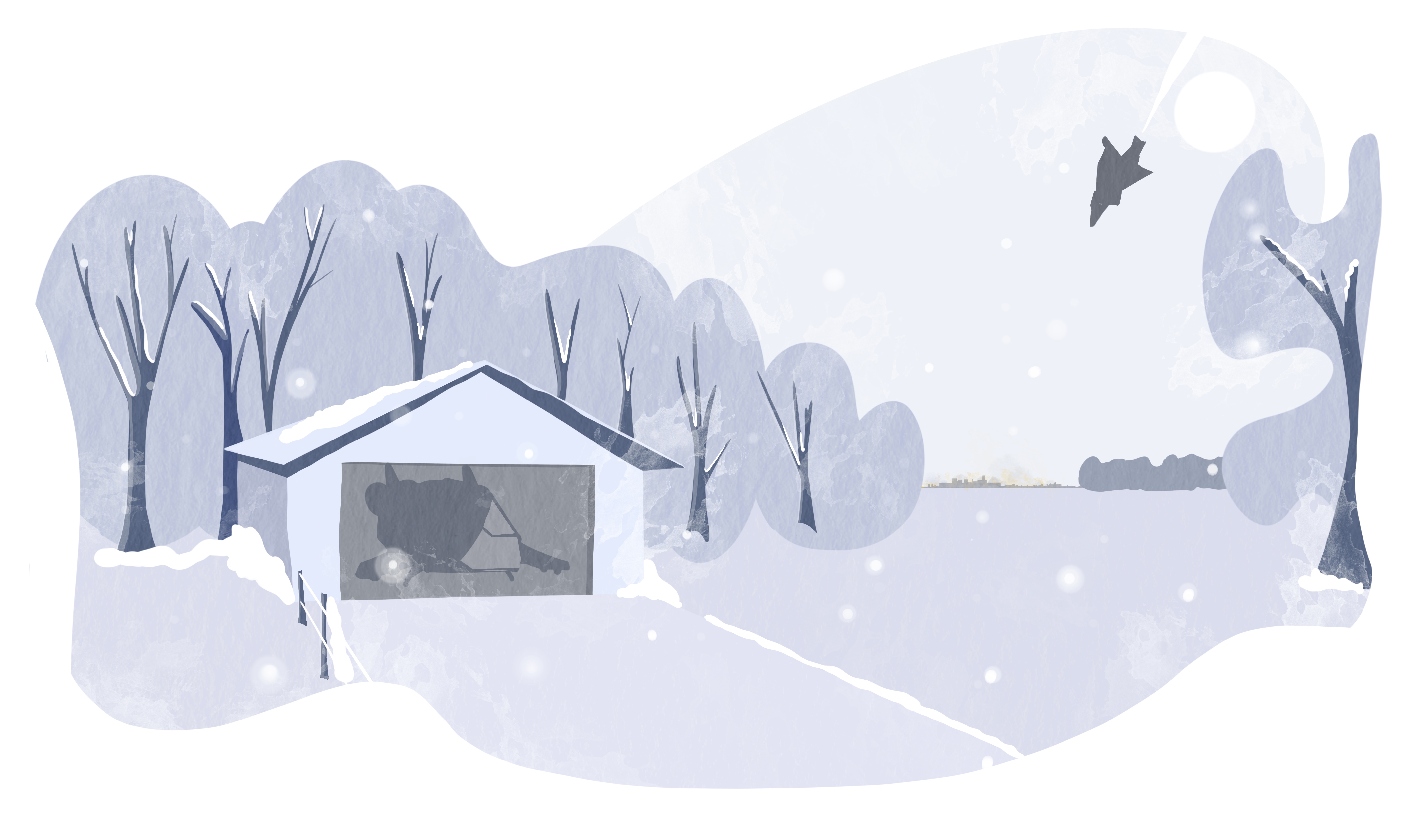
Artwork courtesy of my guy, Usher, @mattusher_art, and a huge thank you to my beta readers LB, PV and CS, without whose feedback and editing this story may never have seen the light of day.
It’s been a labour of love. Alkonost started life in January 2021 and I finished a draft early. But editing is not my first love, and with the Russian war in Ukraine beginning in early 2022, it felt like a poor time to publish something that showed Russian-inspired government officials as sympathetic. I’m glad this story exists and brings to life some years of worldbuilding and ideas I’ve had for my long neglected novel, Wolf on the Fold.
If you made it this far, thank you. I love this story and it helped me process my own grief, and feeling a loss of agency and isolation in those pandemic years.
This is a work of fiction. Names, characters, places and incidents either are products of the author’s imagination or are used fictitiously. Any resemblance to actual events or locales or persons, living or dead, is entirely coincidental.


Wonderful ♥️
LikeLiked by 1 person